The 2.89MB time-series engine for edge & IoT.
Beacon is a single-binary Rust TSDB: Gorilla compression, a crash-safe write-ahead log, real-time SSE streaming, and a zero-dependency dashboard compiled straight into the executable. One process, one file, no sidecars.
cargo install --git https://github.com/prxmel4/beacon
beacon serve --port 8086 --data-dir ./beacon-data
git clone https://github.com/prxmel4/beacon.git && cd beacon
cargo build --release
./target/release/beacon serve --port 8086 --data-dir ./beacon-data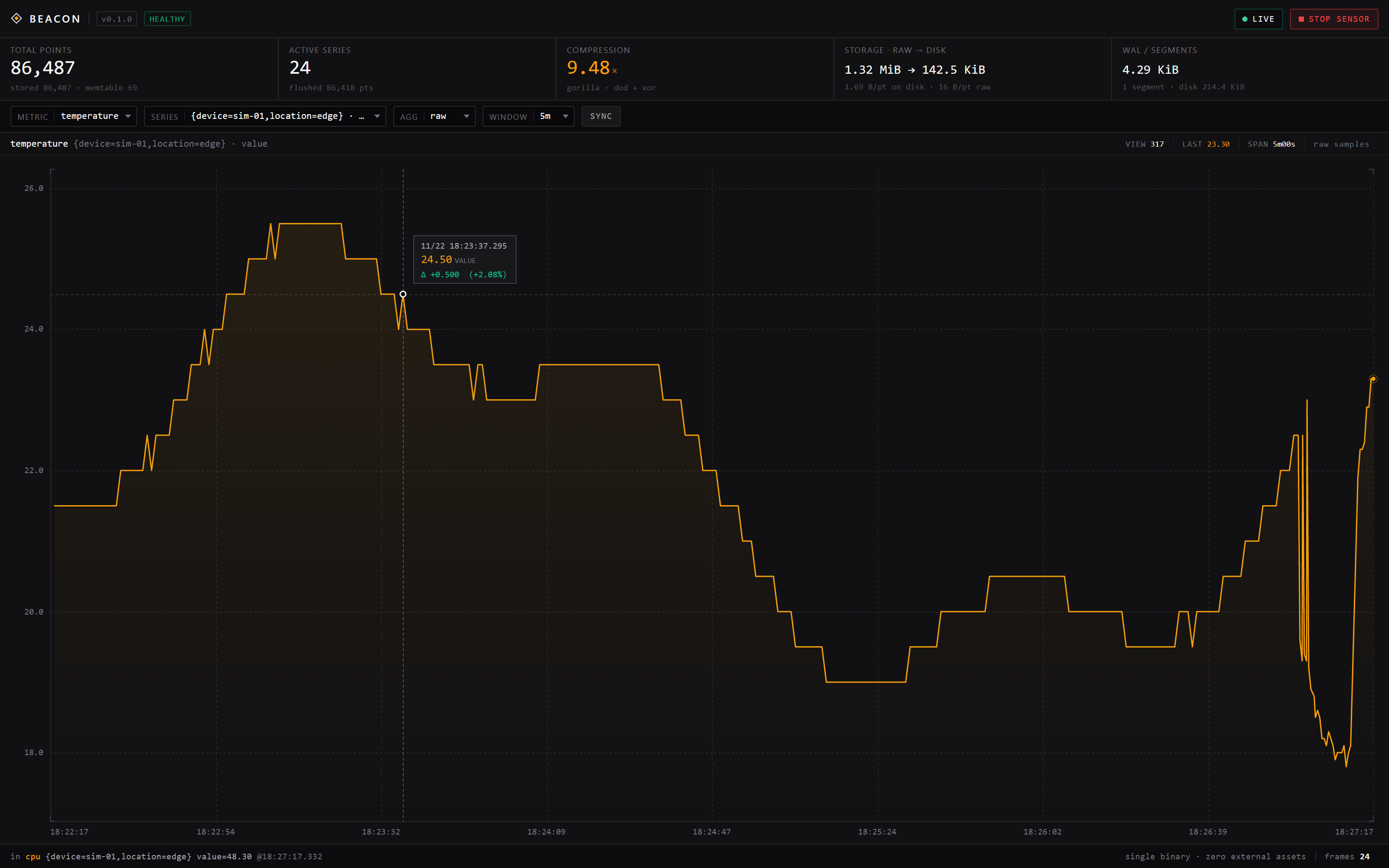
Measured on this repository, not a slide deck.
beacon bench --points 1000000 · release build · 24 series · 200 queries
Sustained ingest with WAL fsync and Gorilla flush included.
Gorilla DoD + XOR: 1.53 B/point on disk vs 16 raw.
200 random 1%-window aggregations · p50 26 µs · p99 71 µs.
Static binary + 35.1 KB embedded UI. No runtime, no assets.
Throughput varies ±10% between runs — 552K / 608K / 615K pts/sec across three runs, fsync-bound on the host disk.
Full-scan count over 333,334 points: 4.47 ms
One process, from write-ahead durability to a 60fps canvas.
No external services · no message bus · no sidecars · no GC pauses
compress → append → fsync → truncate WAL
The WAL is only cleared after the segment is durable.
replay + timestamp dedup
A crash between fsync and truncate replays already-flushed points.
no acknowledged write is lost
Only an unacknowledged tail can be discarded.
Everything an edge deployment needs. Nothing it doesn't.
Zero runtime dependencies in the shipped binary
Gorilla compression
01Delta-of-delta timestamps plus XOR-encoded floats, bit-packed by a hand-written writer. Sixteen bytes of raw point becomes 1.53 B on disk.
Crash-safe WAL
02Every acknowledged write is CRC32-framed and fsynced before the response. A torn tail is detected and truncated on startup, and replay is idempotent by timestamp.
Air-gap ready UI
03The dashboard is a 35.1 KB document compiled into the binary. No CDN, no npm, no web fonts — it renders on a LAN with no route to the internet.
Zero-panic core
0471 tests, 0 clippy warnings, 0 unsafe blocks in the codec and storage paths. Protocol errors come back as typed JSON carrying the offending line number.
Line protocol
05InfluxDB-compatible ingestion: multi-field writes, escaped keys, integer/unsigned/boolean suffixes, comment lines and multi-line batches validated atomically.
Real-time SSE
06A bounded broadcast channel fans parsed points out to browsers. Slow subscribers get a lagged notice and resync instead of back-pressuring ingest.
Zero to telemetry in three steps.
Rust toolchain or a prebuilt binary · Windows, Linux, macOS
- 01
Install or build
One Cargo command gets you running. Source builds need Rust 1.85+from rustup.rs; prebuilt binaries are on the Releases page if you would rather skip the toolchain.
cargo · rustup.rs · releasesShell# prereq: Rust 1.85+ (https://rustup.rs) cargo install --git https://github.com/prxmel4/beacon # or build it yourself git clone https://github.com/prxmel4/beacon.git && cd beacon cargo build --release - 02
Launch & open console
Start the server, open http://127.0.0.1:8086, then press MOCK SENSOR in the top bar to watch live 60fps telemetry appear immediately.
dashboard · embedded · 60fpsShellbeacon serve --port 8086 --data-dir ./beacon-data # from a source build: # Windows .\target\release\beacon.exe serve ... # Linux / macOS ./target/release/beacon serve ... - 03
Send real data
Write line protocol to POST /api/v1/write from a shell, PowerShell script or ESP32 — then read it back withGET /api/v1/query. Timestamps are optional.
write · query · streamEndpoints# single point curl -sS -X POST http://127.0.0.1:8086/api/v1/write \ --data-binary 'cpu,device=edge-07,room=lab value=41.5 1732250000000' # raw range query curl -sS 'http://127.0.0.1:8086/api/v1/query?metric=cpu&from=1732250000000&to=1732250060000' # live SSE frames (Ctrl+C to stop) curl -sN 'http://127.0.0.1:8086/api/v1/stream'Endpoints# write a batch (timestamps are Unix milliseconds) $body = @" temperature,device=sensor-01,room=kitchen value=28.5 1732250000000 humidity,device=sensor-01 value=61i 1732250000000 "@ Invoke-RestMethod -Method Post -Uri http://127.0.0.1:8086/api/v1/write -Body $body # tag-filtered average over the whole series Invoke-RestMethod "http://127.0.0.1:8086/api/v1/query?metric=temperature&tag=device=sensor-01&agg=avg" Invoke-RestMethod "http://127.0.0.1:8086/api/v1/stats"Endpoints#include <WiFi.h> #include <HTTPClient.h> #include <time.h> const char* BEACON = "http://192.168.1.50:8086/api/v1/write"; void sendSample(float tempC) { if (WiFi.status() != WL_CONNECTED) return; // Beacon timestamps are Unix milliseconds; omit it and the server uses now(). long long ts = (long long)time(nullptr) * 1000LL; String line = "temperature,device=esp32-01,room=lab value=" + String(tempC, 2) + " " + String(ts); HTTPClient http; http.begin(BEACON); http.addHeader("Content-Type", "text/plain"); int code = http.POST(line); // 200 -> {"points_written":1} http.end(); }Tabs are pure CSS (radio inputs + sibling selectors) — no framework, no hydration, no layout shift. The whole site ships as static HTML.